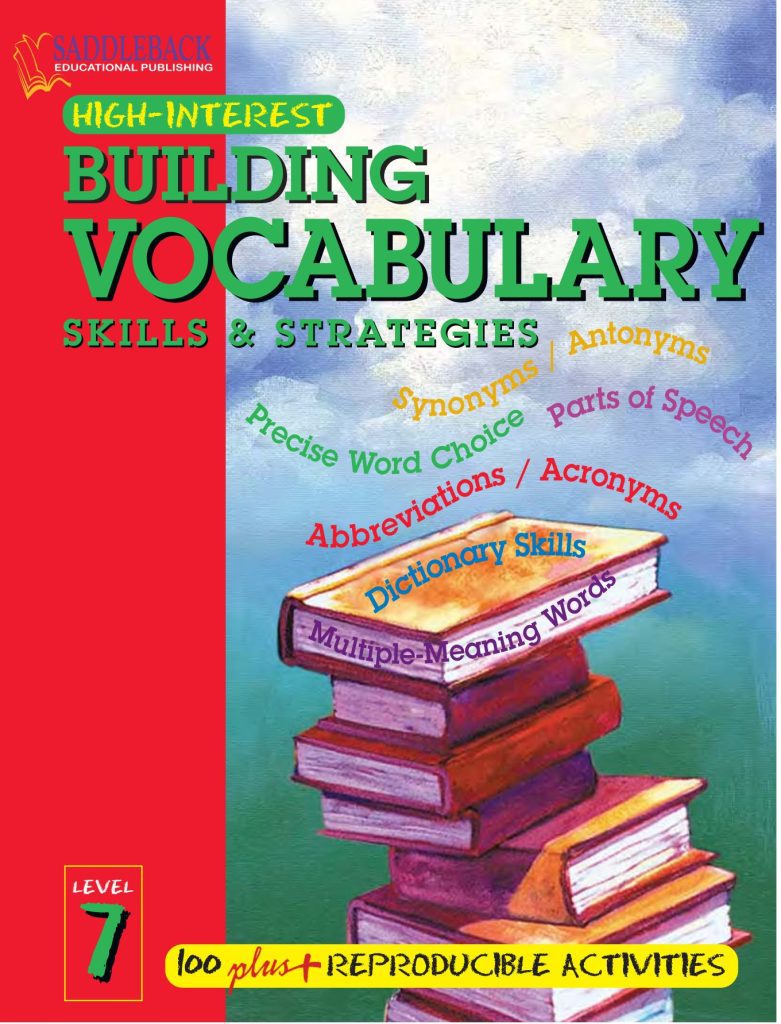
About This Book
Building Vocabulary Book 7 is the seventh book of a vocabulary-building course — an extension workbook for pupils who completed the core sequence. It is a practice book in the strict sense: words pursued into harder territory, with the method of the earlier books now assumed rather than taught, and the difficulty raised accordingly.
Extension volumes occupy an honourable place in education: they exist because some pupils finish the course and ask, reasonably, what is next. For vocabulary, the honest answer is ‘the same work, at the depth where it starts paying compound interest.’ Book 7 operates at that depth. Etymology stops being story-time and becomes analysis — tracing how a word’s journey through languages predicts its modern behaviour. Academic vocabulary stops being a school list and becomes reconnaissance: the words of secondary textbooks seized a year before those textbooks arrive, so that the transition’s famous vocabulary cliff is climbed in advance, roped and unhurried. Most distinctively, ambiguity becomes a subject in its own right. The pupil who has only met words behaving well has been sheltered; real instructions, real headlines, and real examination questions contain words planted to mislead, and Book 7 trains the counter-habit — read the word, then read the word’s situation — until wariness is automatic.
What Learners Will Practise
Etymology as Analysis
Learners practise word history with intent: using a word’s origins and travels to predict its meaning, register, and relatives in unfamiliar company. What was a memory hook in the middle books becomes an instrument here — the difference between knowing a story about a word and being able to interrogate a stranger with it.
Secondary Words, Early
The book practises the formal vocabulary of the coming subjects — the language of science reports, historical argument, and mathematical reasoning — inside sentences pitched at extension level. Pupils meet the words as readers before they must survive them as students, which reverses the usual order of the secondary transition and removes its sting.
Auditing Ambiguity
Exercises plant the traps deliberately: instructions that hinge on one word’s second sense, headlines that mean two things at once, questions whose wording decides their answers. Pupils learn to catch the hinge word before it swings — a vigilance that serves examinations, contracts, and every form they will ever sign.
Key Features
The extension pitch is the feature: the course’s method applied at genuine stretch, for pupils who earned the harder room. The ambiguity training is the second, rare at this level and invaluable everywhere, and the workbook format the third — the familiar short bouts, now carrying advanced weight. In this collection it is the vocabulary shelf’s extension volume.
Who This Book Is For
Graduates of the core course whose appetite survived it are its first audience — the book exists for them specifically. Teachers form its second readership, differentiating for the pupil who finishes everything early and asks for more. Parents make its third: choosing Book 7 is choosing to feed a strength rather than patch a weakness, and children notice the difference between those two kinds of extra work.
How to Use This Book
Let the pupil set the pace entirely: extension work dies under compulsion and thrives under appetite, so a chapter chosen beats a chapter assigned. Pair it with real reading at full stretch — the first adult nonfiction the pupil has wanted to attempt — because Book 7’s skills are calibrated for exactly that border crossing, and the crossing is the celebration the course has been pointing at for seven books.
Related Books
The vocabulary shelf’s senior core volume stands at Building Vocabulary Book 6, and its fifth volume waits at Building Vocabulary Book 5.