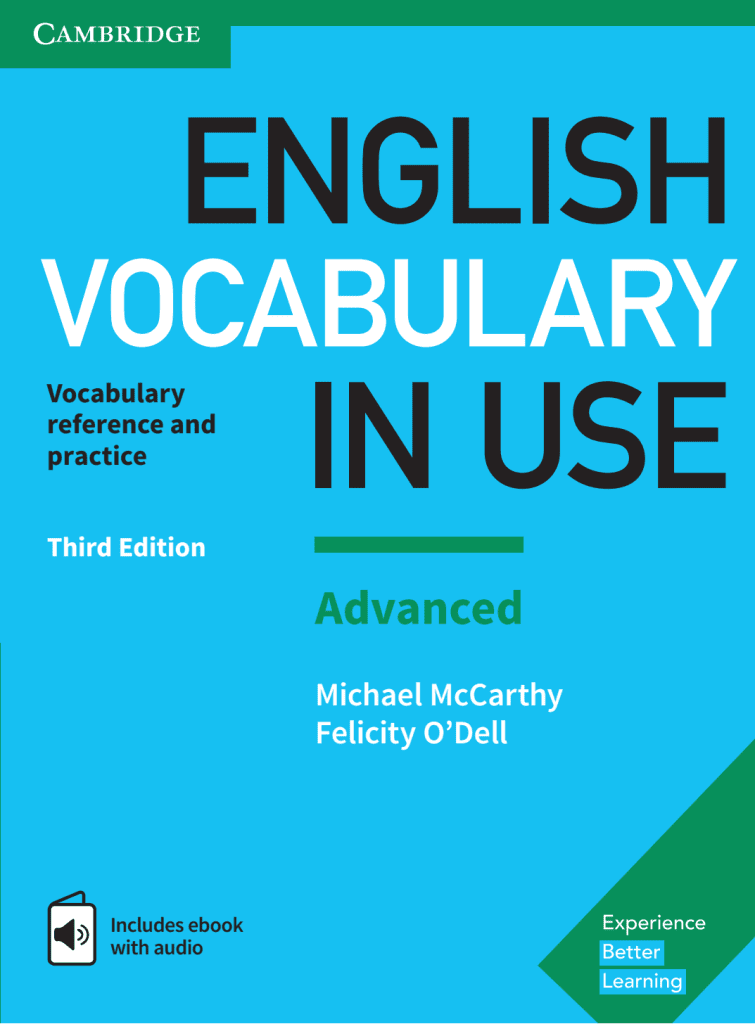
About This Book
English Vocabulary in Use Advanced is the advanced level of the In Use family’s vocabulary line. The destination heading gives the exact title; the file served there, ‘English Vocabulary in Use Advanced.pdf’, carries the exact title itself — the same volume under the filename the site serves it by. The book’s work is refinement: the vocabulary of precision, organised for learners who already communicate well and intend to communicate exactly.
Advanced learners face a peculiar frustration: their errors stop being errors. Every sentence is correct, and yet the writing reads as almost-English — the word chosen is a cousin of the word meant, the collocation is legal but unidiomatic, the register drifts half a tone off. Native readers feel it without naming it, and the learner feels it without fixing it, because ordinary dictionaries certify the cousin as correct. What this stage needs is not more words but finer ones: vocabulary taught with its shades attached — which synonym persuades and which merely informs, which verb a report takes and which it refuses, how word families build academic nouns from everyday verbs. An advanced volume in the In Use manner teaches exactly that fineness: items presented in real contexts where their connotations are visible, contrasts drawn between near-neighbours, and practice that forces choice rather than recognition. It is, in a sense, a book about taste — the educated preference for the exact word — and taste, unlike correctness, cannot be crammed the night before; it is accumulated item by considered item. For the learner aiming at examinations, publication, or professional authority, this accumulation is the last large project of vocabulary study, and the most enjoyable.
What Learners Will Practise
Shades of Meaning
Learners practise discriminating near-synonyms — the differences of strength, tone, and implication that decide whether a sentence persuades. Precision is a discrimination skill before it is a knowledge skill.
Collocation and Company
The book practises the partnerships words keep at advanced levels, because idiomatic English is largely correct company. A right word in wrong company still reads as translated.
Word Families and Formation
Readers practise building across families — verb to noun to adjective — the derivational fluency academic and professional English runs on. Families multiply a vocabulary without multiplying the learning.
Key Features
The precision focus is the feature: vocabulary as discrimination, in the In Use teach-then-practise design. The context-first presentation is the second — shades visible only in use — and the shelf fit the third, the refinement volume beside this list’s advanced phrasal verbs and IELTS vocabulary. On this shelf it sharpens the blade here.
Who This Book Is For
Advanced learners polishing toward mastery are its first audience. Academic and professional writers form its second readership, whose words carry authority. Teachers make its third, modelling the standard their students copy.
How to Use This Book
Study contrasts, not items: when two synonyms appear, write the sentence where only one survives. Keep a precision notebook of your own recurring almost-words and their exact replacements. Read actively with it nearby; advanced vocabulary grows fastest when hunted in real texts.
Related Books
The shelf’s advanced phrasal verbs stand at English Phrasal Verbs in Use Advanced, and its advanced IELTS vocabulary at English Vocabulary for IELTS Advanced Book.